Huddersfield drives collaboration on tackling serious and organised crime
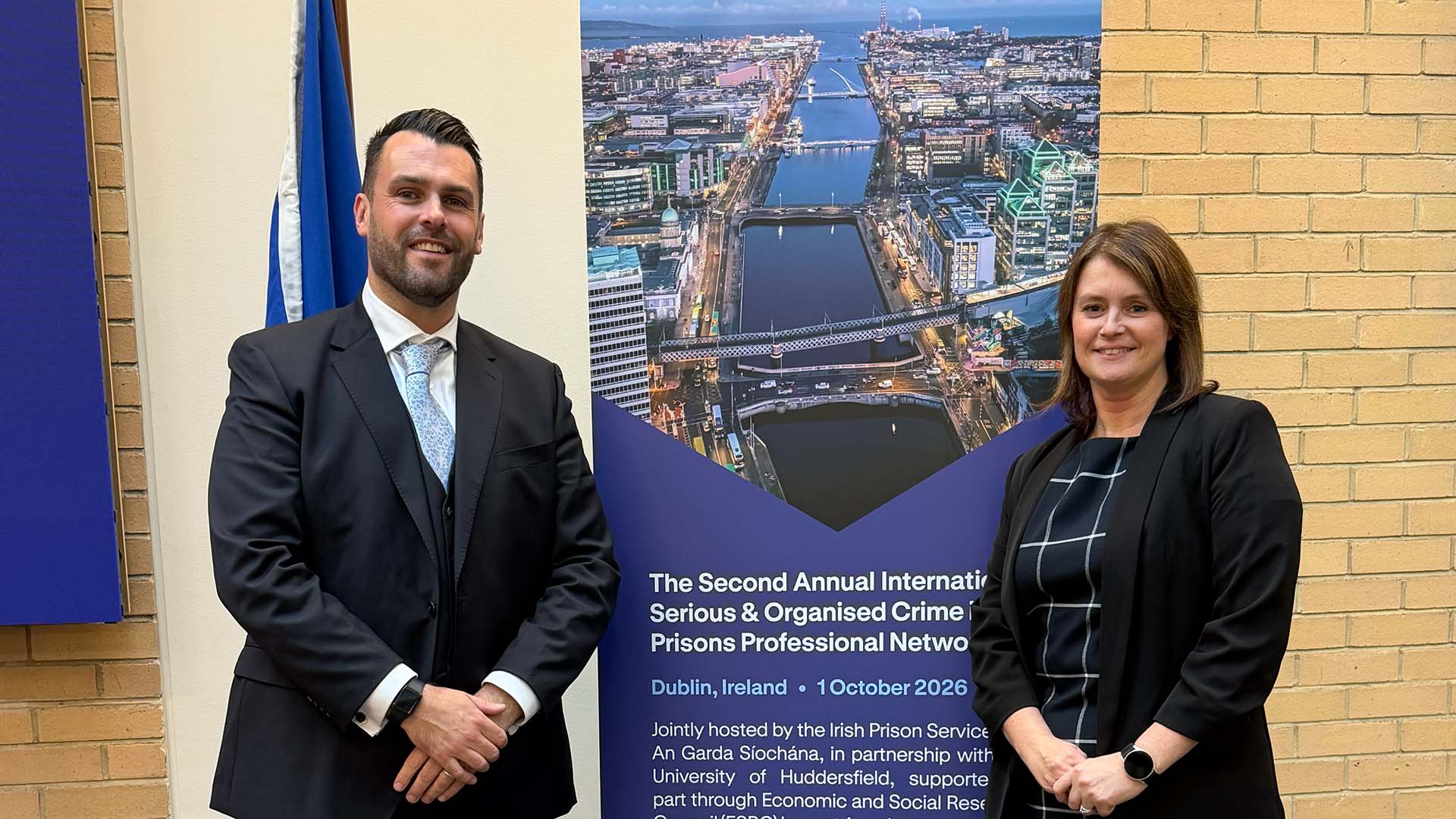
How to address the growing challenges posed by serious and organised crime in prisons at a local, national and international level was at the heart of a conference coordinated by the University of Huddersfield’s Professor John Synnott in Dublin recently.
More than 110 senior leaders and practitioners from over 35 organisations gathered at Dublin’s Department of Justice for the second annual International Serious and Organised Crime in Prisons Professional Network event on 30 September and 1 October.
The two-day event brought together senior representatives from policing, prisons, government and partner agencies from across Ireland, the UK, Europe and further afield, and was hosted by the Irish Prison Service and An Garda Síochána, building on the inaugural international conference held at Merseyside Police Headquarters in 2025.
The 2026 event was part-funded through an Economic and Social Research Council (ESRC) Impact Acceleration Account award to Professor John Synnott, supporting the translation of research, professional expertise and international collaboration into real-world impact.
From Liverpool to an international professional network
The initiative was established to create a dedicated forum, in which those working at strategic and senior operational levels across policing and prisons could openly examine the challenges posed by organised criminality within and beyond the prison estate.
Following the success of the Liverpool event, the network has expanded significantly in both scale and international reach.
Professor Synnott, Professor of Forensic and Investigative Psychology at the University of Huddersfield and convenor of the international network, said, “When I established this network in Liverpool last year, the ambition was to create something that went beyond an annual conference.
Twelve months later, we have doubled both the number of delegates and jurisdictions represented, and we are already seeing relationships formed through the network develop into practical collaboration and new formal arrangements between policing and prison partners.
Professor John Synnott

“What makes the model different is that we deliberately create the time and space for people to think, talk and build relationships. Academia is very good at creating space to properly understand a problem before deciding how best to respond — something that can be difficult in fast-moving operational environments. Bringing senior colleagues together in that environment, across agencies and jurisdictions, is where I think this network can add real value.”
Alongside the formal programme and gala dinner, the Irish Prison Service facilitated a visit to Kilmainham Gaol, while delegates also had the opportunity to experience traditional live music. These elements created meaningful opportunities for delegates to spend time together outside the formal conference setting, helping to build trust, strengthen relationships across agencies and jurisdictions, and establish professional connections that can be drawn upon when challenges arise.
Tackling a shared international challenge
Across the two days, delegates considered some of the most significant challenges facing prison and law-enforcement systems, including,
• intelligence-sharing and inter-agency coordination
• workforce integrity,
• drones and prison infrastructure
• digital communications and emerging threats
• the leadership required to respond to increasingly sophisticated, organised crime networks.
Building lasting international partnerships
Reflecting on the Irish Prison Service’s role in hosting the event, Don Culliton, Director of Operations, Irish Prison Service, said, "When I attended the inaugural event in Liverpool last year, I immediately recognised this as a network the Irish Prison Service could help develop and provide leadership to. Hosting it in Dublin allowed us to share what we are doing well, learn from where others are ahead, and tackle common challenges together rather than in isolation. Across prisons and serious and organised crime, many of us face the same problems. This network gives us a way to compare approaches, learn from one another and strengthen relationships across jurisdictions."
Deputy Chief Constable Wendy Gunney, National Police Chiefs' Council lead for Serious and Organised Crime, added, "Serious and organised crime is increasingly international, technologically enabled and highly networked, and we must be equally connected in our response. This conference brought together experts from across law enforcement, prisons and probation to share learning, challenge assumptions and develop stronger partnerships.
"The most powerful message was that collaboration matters. By working together across agencies and jurisdictions, sharing intelligence and learning from one another's experiences, we can better identify, disrupt and prevent organised crime, helping to protect our communities both inside and outside the prison walls.”
Caron McCaffrey, Director General of the Irish Prison Service, also added, “Serious and organised crime presents a complex challenge that requires strong partnerships across organisational and national boundaries. This network provided an important opportunity to strengthen those relationships, share learning and develop practical collaboration between prison and law-enforcement partners internationally."
The Dublin event reflected the increasingly international nature of the network, which provides a mechanism through which senior leaders and practitioners can establish relationships, exchange operational learning and develop collaborative responses to challenges that extend beyond organisational and national boundaries.
Planning is already underway for the 2027 event, as the network continues to expand its international reach and build on the relationships established in Liverpool and Dublin.