Freya’s software innovation boosts visually-impaired game developers

Alumna Freya Shaw has built upon her studies and research at the University of Huddersfield to develop software that helps visually impaired developers to use tools that were previously difficult or inaccessible.
Freya, who is registered blind, devised Hodr Engine, named after a blind god in Norse mythology, following her degree in Animation Production and her Master’s by Research in Music Technologies, both of which she completed at the University between 2020 and 2025.
A software developer, sound designer and musician, Freya founded Immersion Sound Studio while studying. The studio operates out of the 3M Buckley Innovation Centre on campus and has been boosted by awards including a Vice-Chancellor’s Scholarship and Enterprise Grant from the University, and an Unlocking Potential Award from Innovate UK.
“I’ve been interested in developing accessible software for blind, visually impaired and sighted users through my music and sound commissions, mainly for media like video games,” says Freya. “I started during my scholarship research master’s in 2023, and developed the Hodr Engine prototype as software for people of any sight condition or technical skill level to create immersive experiences like video games.
“I was excited to explore how we can further develop software for creating audio-visual media, such as video games, that is accessible to blind and visually impaired people, who often use assistive software like screen readers. I was in my final year when it all started, because I wanted to create a game but struggled to find accessible software, to support me in doing this without having to program a game from scratch.
“I learned to code in Python to develop my own game. Dr Adrian Jackson, a retired University of Huddersfield Computer Science lecturer, was enormously supportive in helping me learn, especially when I was struggling to find accessible material online. After that, I thought, why can’t I develop this software further so other people can do the same?”
How Hodr Engine works
Hodr Engine is a user interface that makes development more accessible. Its core approach reworks three-dimensional open spaces into a grid, making spatial navigation easier for a screen reader to interpret. This creates a clearly segmented arena for users to navigate, making it simpler to place objects and sounds within a space.
There are multiple layers to these grids. If a user wants to incorporate a house into a map for a video game, they can add another editable layer inside the house. Preset environments for game design are also provided, which users can build upon or reshape.

Freya continues, “Existing game engines are incredibly powerful tools but they can also be visually very complex. Assistive software like screen readers can struggle to convey what’s on screen, particularly when buttons are incorrectly labelled, images lack alt text and user interface layouts are complicated. This often renders these industry-wide tools inaccessible to this underserved but talented community.”
Dr Alex Harker, Senior Lecturer in Music and Music Technology, adds, “When supervising Freya’s Masters by Research, during which the first version of the Hodr Engine was created, I was struck by her notable enthusiasm, work ethic and commitment to widening the accessibility of game development. Freya has taken her own experiences of software development, as well as her passion for immersive audio and gaming and created a vitally important tool for addressing issues of inclusion both for gamers and game developers.
“This work is important not only in that it provides a tool through which blind and visually-impaired users can engage with game development, but also in the impact of the project in raising awareness of accessibility issues so that software development in general might become more inclusive. It’s been a pleasure to see this work go out into the world where it can make a real difference.”
Further developments
Such is the impact of Hodr Engine that Freya has discussed its development with key figures in the industry who have worked at Xbox and Sonos, the renowned audio equipment manufacturer.
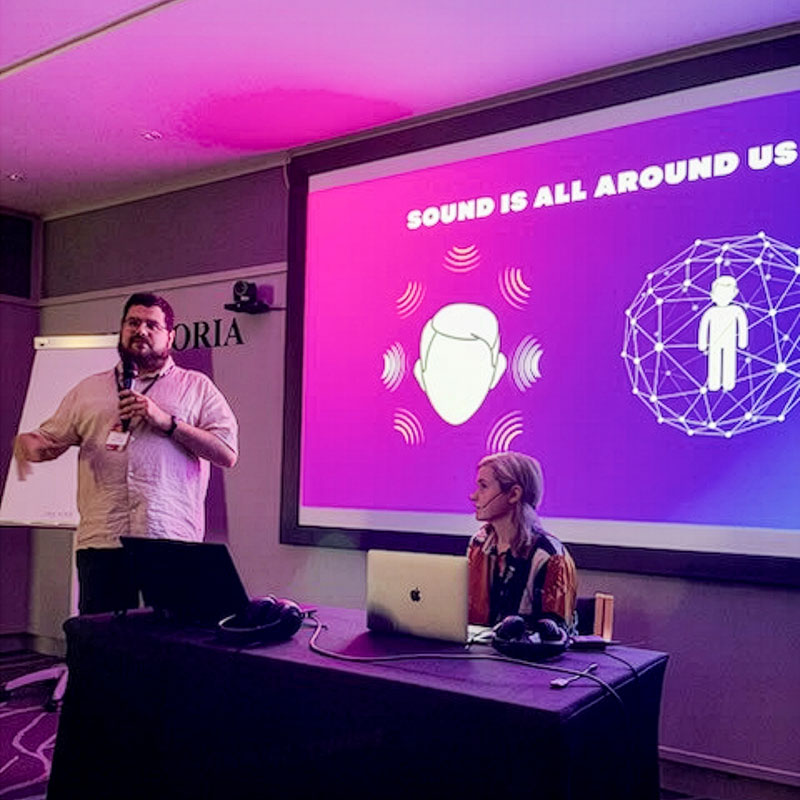
Freya spoke at the Spillkonventet conference in Norway in June 2025, and at Devcom in Cologne later that year. At both events, she spoke to audiences ranging from student developers to large companies about how audio can be used to make visual games accessible to blind and visually impaired players.
In 2026, Immersion Sound Studio is working with Daniel Jones, a creative technologist specialising in spatial audio and digital signal processing, with over two decades of experience in the field. He developed the 3D audio engine for the pioneering audio-only mobile games Papa Sangre (2010) and The Nightjar (2011), which were nominated for two BAFTAs, including Audio Achievement.
Discover more about research scholarships at the University of Huddersfield
A visiting artist and researcher at the Intelligent Instruments Lab at the University of Iceland, he maintains a series of open-source libraries for sound synthesis and composition, including SignalFlow, a Python framework whose spatial audio capabilities form the foundation of Hodr’s audio rendering system.
Immersion Sound Studio are completing Hodr Engine as a standalone audio engine, for users to develop interactive spatial audio environments. The team is also collaborating with companies to make their software accessible through Hodr Engine’s screen reader-friendly user interface, and creating bespoke experiences on commission, supported by the Innovate UK Create Growth grant, with a beta version of the engine ready for demo testing.